Quick Answer: Reinventing yourself doesn’t mean scrapping everything and starting over. These 15 habits to reinvent yourself are small, intentional shifts that build a new version of you, one quiet day at a time. They work especially well for moms and women who are ready to slow down and come back to themselves.
Key Takeaways
- Reinvention starts with small, consistent habits, not dramatic life overhauls
- Changing your environment is one of the fastest ways to shift your mindset
- Learning something new rewires your brain and rebuilds confidence
- Gratitude and self-care are not luxuries; they’re the foundation of lasting change
- Surrounding yourself with the right people matters more than most women realize
- Written goals are significantly more effective than mental ones
- You don’t have to do all 15 habits at once; start with two or three
- Flexibility is part of the process; adjusting your goals isn’t quitting
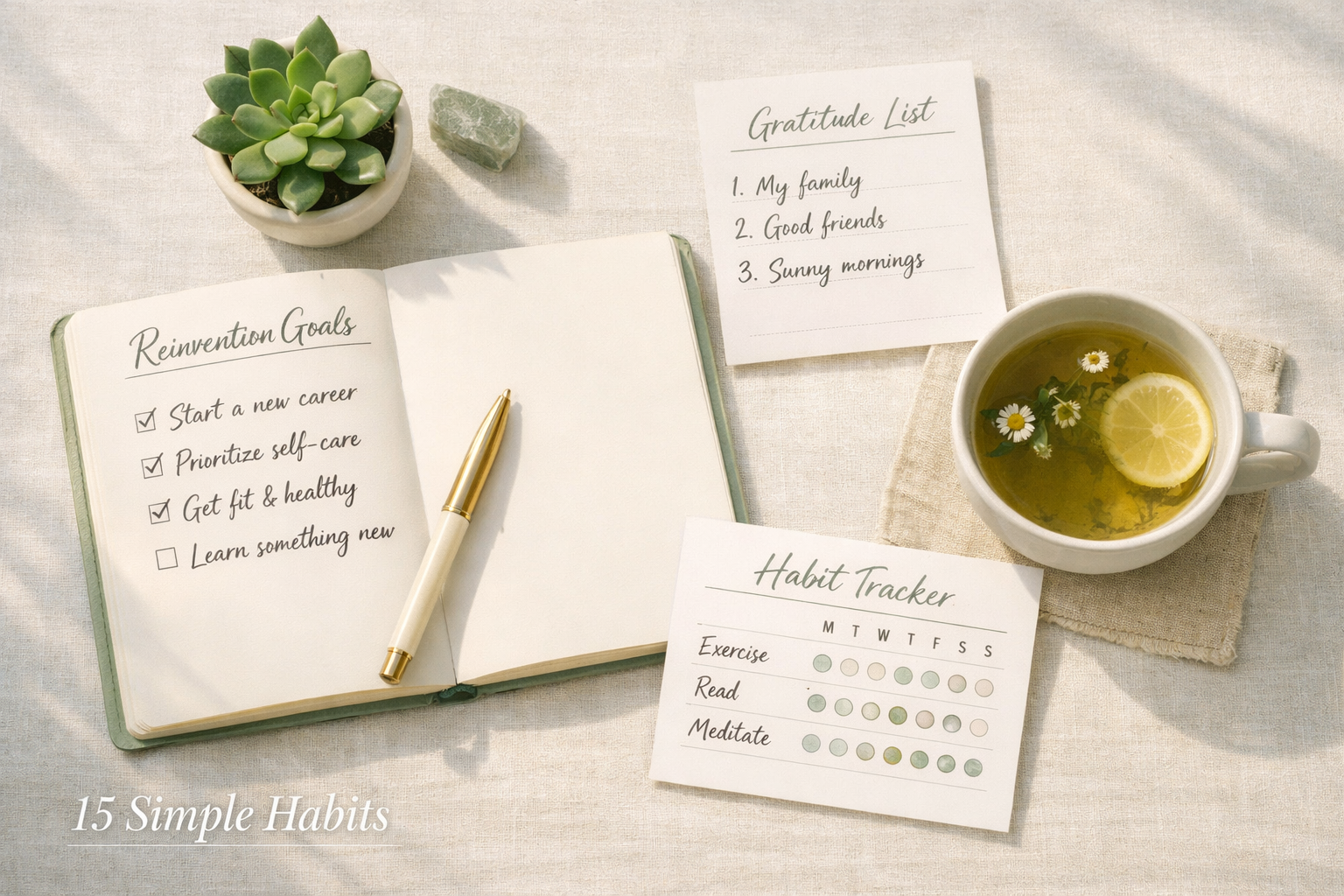
Why Do So Many Women Feel Like They’ve Lost Themselves?
Life has a way of quietly burying the real you under years of doing for everyone else. For moms especially, the shift happens gradually. One day you realize you can’t remember the last time you did something just for you.
Reinventing yourself isn’t about becoming someone unrecognizable. It’s about returning to who you were before the world told you to shrink, and then growing from there.
These 15 habits to reinvent yourself are designed for women who are tired but ready, who want change without chaos.
What Are the 15 Habits To Reinvent Yourself?
Here they are, laid out simply. You don’t need to tackle all 15 at once. Pick two or three that feel right and build from there.
1. Wake up before the noise starts
Getting up by 6:30 AM gives you uninterrupted time that belongs only to you. Even 30 quiet minutes before the household wakes up can change the entire tone of your day.
2. Start a brand new journal
There’s something powerful about opening a fresh page. It signals to your brain that a new chapter is beginning. Write whatever comes, no rules, no pressure.
3. Write your goals down in specific language
“I want to feel better” is too vague. “I will walk for 20 minutes three mornings a week” gives your brain something to act on. Specific written goals keep you focused when motivation dips.
4. Switch up your daily routine intentionally
Try doing one full day completely differently. Take a new route, eat something unfamiliar, rearrange your morning. Breaking automatic patterns forces you to pay attention again.
5. Learn one new skill for 30 days
Learning something new, whether it’s sourdough, watercolor, or a new language, actually changes your brain chemistry. It also rebuilds the kind of confidence that comes from proving something to yourself.
6. Change your physical environment
Your surroundings shape your behavior more than you think. Rearranging a room, clearing a corner, or adding a plant can shift how you feel and what you do in that space.
7. Try something completely new every week
A new recipe, a different coffee shop, a hairstyle you’ve been eyeing for two years. Small experiments like these reduce fear around change and remind you that you’re still someone who grows.
8. Build one tiny habit at a time
Keep your workspace tidy. Read five pages of something inspiring each morning. Step outside for ten minutes after lunch. Tiny habits stack quietly and create real momentum over time.
9. Prioritize self-care across three areas
Physical (sleep, movement, food), emotional (processing feelings, setting limits), and mental (rest, creativity, learning). When all three are tended to, even imperfectly, you have more to give.
10. Practice gratitude every single day
This isn’t about toxic positivity. It’s about training your brain to notice what’s working, not just what’s missing. A short list each morning or evening is enough.
11. Surround yourself with people who see your potential
The people around you either lift your ceiling or lower it. You don’t need to cut anyone off dramatically, but you do need to be honest about whose company leaves you feeling smaller.
12. Set clear limits without guilt
Saying no to one thing is saying yes to something that actually matters to you. Limits aren’t walls; they’re the shape of a life that fits.
13. Spend time in silence daily
Even five minutes without a screen, a podcast, or background noise gives your mind space to process and reset. Most women are chronically overstimulated and don’t realize it.
14. Be flexible with your reinvention plan
If a goal stops feeling aligned with who you’re becoming, it’s okay to adjust it. Flexibility isn’t failure; it’s wisdom. Reinvention is a living process, not a fixed destination.
15. Celebrate small wins out loud
You finished the book. You made the appointment. You said no when you meant it. These moments deserve recognition. Celebrating them trains your brain to keep going.

How Long Does It Take To Reinvent Yourself?
Meaningful change takes months, not days, but you’ll feel the shift much sooner than you expect. Most women notice a difference in their mood and energy within two to four weeks of building even one or two of these habits consistently.
A rough timeline to set realistic expectations:
| Timeframe | What You Might Notice |
|---|---|
| Week 1-2 | Slight resistance, then curiosity |
| Week 3-4 | Small wins, improved mood |
| Month 2-3 | Habits feel more natural, confidence grows |
| Month 4-6 | Identity starts to shift noticeably |
| 6+ months | Others begin to notice the change too |
Common mistake: Expecting to feel motivated every day. Motivation comes and goes. The habit is what carries you through.
Which of These 15 Habits Should You Start With?
Start with whichever habit causes the least resistance and the most excitement. That combination is a reliable signal.
Choose the journaling habit if you’re feeling emotionally cluttered and need to process before you can plan. Choose the environment habit if your surroundings feel heavy or stuck. Choose the tiny habit approach if you’re overwhelmed and need a win that feels doable today.
Avoid starting with the hardest habit on the list. That’s a setup for quitting. Momentum matters more than ambition at the beginning.
What Mistakes Do Women Make When Trying To Reinvent Themselves?
The biggest mistake is trying to change everything at once. Reinvention done this way burns out fast and usually ends with a return to old patterns plus a side of guilt.
Other common missteps:
- Waiting for the “right time” (it doesn’t exist)
- Keeping goals vague and unmeasured
- Isolating during the process instead of finding community
- Treating setbacks as proof that change isn’t possible
- Comparing their chapter one to someone else’s chapter ten
Conclusion
Reinventing yourself isn’t a dramatic event. It’s a series of quiet, consistent choices that slowly add up to a life that actually feels like yours.
These 15 habits to reinvent yourself are not a checklist to rush through. They’re an invitation to slow down and pay attention to what you actually want, maybe for the first time in a long time.
Your next step: Pick one habit from this list and do it today. Not tomorrow, not Monday. Today. Write one sentence in a new journal. Step outside for ten minutes. Text one person who makes you feel like yourself.
That’s how it starts. One small, honest choice at a time. 🌿
Frequently Asked Questions
Can I reinvent myself as a mom with very little free time?
Yes, and these habits were designed with that in mind. Most of them take five to fifteen minutes. The goal is not to add more to your plate but to shift what’s already there.
Do I need to reinvent myself all at once?
No. Picking two or three habits and doing them consistently for a month is far more effective than attempting all 15 at once and burning out by week two.
What if I start and then fall off track?
You start again. There’s no streak to protect here. Returning to a habit after a break is itself part of building it.
Is reinventing yourself selfish when you have a family?
It’s the opposite. A woman who knows who she is and tends to herself is more present, more patient, and more genuinely available to the people she loves.
How do I know which habits will work for me?
Start with the ones that make you feel a small flutter of excitement or relief when you read them. Your gut usually knows before your brain catches up.
What if my goals change partway through?
That’s not failure; that’s growth. Adjusting your goals as you learn more about yourself is a sign the process is working.
Do I need to wake up at 6:30 AM specifically?
Not exactly. The point is finding quiet time before the demands of the day begin. If your household wakes at 5 AM, adjust accordingly. The principle matters more than the clock.
Can these habits help with anxiety or burnout?
Many women find that habits like silence, gratitude, and setting limits significantly reduce anxiety over time. These aren’t a replacement for professional support, but they do create a steadier internal baseline.