
Quick Answer: When the mental spiral starts, the fastest way out is to redirect your body and your attention at the same time. The 25 things to do instead of overthinking listed here work because they give your brain a real job to do, something concrete, sensory, or creative, so the loop of “what ifs” simply has less room to run. These strategies are especially useful for moms, caregivers, and women who are actively choosing a slower, more intentional life.
Key Takeaways
- Overthinking is a habit, not a personality flaw, and it can be interrupted with the right replacement activity.
- Physical movement, even a short walk, is one of the fastest ways to quiet a busy mind.
- Grounding yourself in the present moment (naming what you’re doing out loud or mentally) conserves mental energy quickly.
- Journaling helps because putting specific words to worries reduces their emotional grip.
- Gratitude lists, nature time, and helping others all shift the brain away from rumination.
- Time-boxing decisions (giving yourself a set window to decide, then stopping) prevents endless mental loops.
- Small environmental cues, like sticky notes with simple reminders, can interrupt overthinking before it builds momentum.
- You don’t need to do all 25. Pick two or three that feel natural and rotate from there.
Why Do Women Tend to Overthink More?
Overthinking shows up for a lot of reasons, but for moms and women in a caregiving role, it often comes from carrying too many responsibilities at once. When you’re managing everyone else’s needs, your brain stays in planning mode almost constantly. That’s not a flaw. It’s a pattern that made sense at some point, but it doesn’t have to be permanent.
The good news is that the brain responds well to redirection. You don’t have to “think your way out” of overthinking. You just need something better to do with that mental energy.
The Full List: 25 Things To Do Instead Of Overthinking
Here are 25 practical, gentle, and genuinely helpful alternatives to the spiral. Some take five minutes. Some take an afternoon. All of them work.
Move your body first:
- Go for a walk, even just around the block. Movement shifts your nervous system out of alert mode faster than almost anything else.
- Stretch for ten minutes. Put on a playlist you love and move slowly. No yoga experience needed.
- Dance in your kitchen. Sounds silly. Works every time.
- Do a short workout. Even fifteen minutes of movement changes your brain chemistry in a measurable way.
Use your hands:
- Cook or bake something from scratch. Following a recipe keeps your attention anchored to steps, not worries.
- Garden or tend to houseplants. Touching soil and greenery has a genuinely calming effect on the nervous system.
- Do a craft project. Knitting, painting, collaging, or even coloring books count.
- Rearrange a small space in your home. The physical act of changing your environment can shift your mental state.
Ground yourself in the present:
- Name what you’re doing out loud. Say “I am washing dishes” or “I am folding laundry.” It sounds simple because it is, and it works because it pulls your attention back to right now.
- Use the STOP method. Stop what you’re doing, take a slow breath, observe what’s happening around and inside you, then proceed with one small next step.
- Hold something cold or warm. A glass of ice water or a hot mug of tea engages your senses and interrupts the thought loop.
- Step outside and notice five things. A tree, a sound, the temperature of the air. Nature replaces anxious thoughts with present-moment observations.
Write it out:
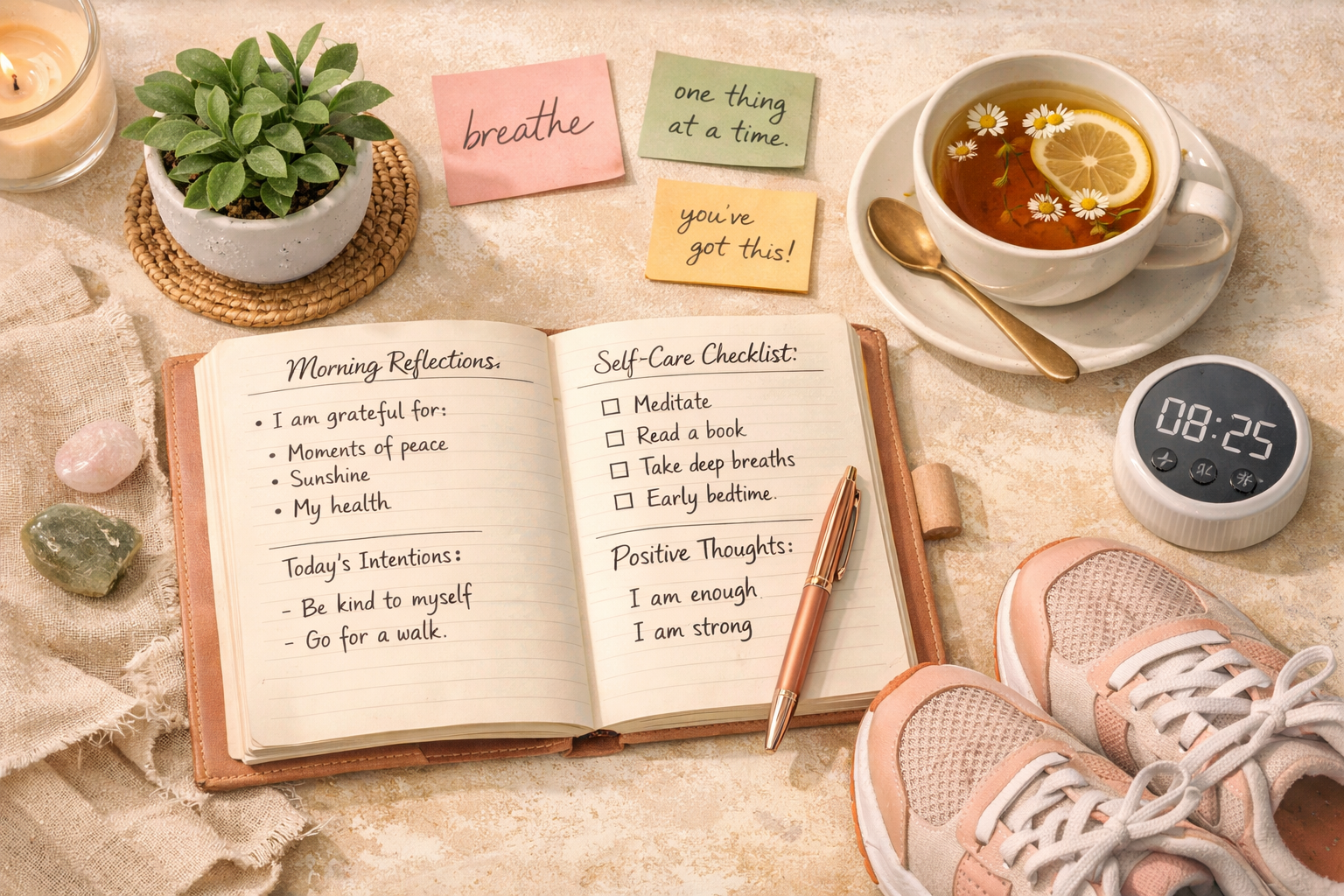
- Brain dump in a journal. Don’t edit. Just write every thought until the page feels heavier than your head.
- Write a gratitude list. Five things you appreciate right now. Specific is better than general (“my daughter’s laugh this morning” beats “my family”).
- Write down the actual worst case. Then write what you’d do if it happened. Most fears shrink when they’re on paper with a plan next to them.
Connect with others:
- Text a friend just to say you’re thinking of them. Shifting focus outward breaks the inward spiral.
- Volunteer or help someone with a task. Helping others activates the brain’s reward system and replaces the helplessness that feeds rumination.
- Call someone you love. Not to vent necessarily, just to connect.
Learn or create something:
- Start learning something new. A language app, a YouTube tutorial, a new recipe category. Redirecting mental energy toward learning is productive and genuinely absorbing.
- Read a physical book. Not your phone. A real book, ideally fiction, so your brain gets to live somewhere else for a while.
- Listen to a podcast or audiobook on a topic you’re curious about. Curiosity and anxiety can’t fully coexist.
Set limits on the thinking itself:
- Time-box your worry. Set a fifteen-minute timer for a simple decision or thirty minutes for a complex one. When the timer goes off, you’re done for now. Your brain keeps working in the background.
- Make a decision and commit for 24 hours. Revisit it tomorrow. Most decisions don’t need to be perfect today.
Create a calmer environment:
- Put up simple visual reminders. A sticky note that says “one thing at a time” or “let it be” on your mirror or laptop can interrupt a spiral before it starts.
- Create a short wind-down ritual. Ten minutes before bed: dim the lights, put the phone down, do something quiet. Overthinking peaks at night, and a ritual signals your brain that the day is done.
How To Know Which Strategy To Use When
Not every tool fits every moment. Here’s a simple way to choose:
| What’s happening | Try this first |
|---|---|
| You’re physically restless | Walk, dance, stretch |
| You’re stuck on a decision | Time-box it, then journal |
| You feel disconnected | Call someone, volunteer |
| You’re spiraling at night | Wind-down ritual, gratitude list |
| You’re home and distracted | Cook, garden, craft |
| You need a quick reset | STOP method, name what you’re doing |
Common Mistakes That Keep the Overthinking Loop Going
Even with the best intentions, a few habits make overthinking worse:
- Trying to think your way to calm. Analyzing the anxiety just adds more thoughts. The exit is through action, not more thinking.
- Waiting until you feel ready to act. The calm usually comes after you start moving, not before.
- Choosing passive distractions like scrolling. Social media gives the brain input but not engagement. It rarely stops a spiral and often makes it worse.
- Expecting one strategy to work every time. Rotate. What works on a Tuesday morning may not work at 11pm on a Friday.
FAQ
What is the fastest way to stop overthinking right now?
The fastest reset is physical. Stand up, take three slow breaths, and name five things you can see. This grounds you in the present moment within about sixty seconds.
Is overthinking a sign of anxiety?
Overthinking and anxiety often overlap, but not always. Overthinking is a thinking pattern. Anxiety is a broader emotional and physical experience. If overthinking is significantly affecting your daily life, talking to a therapist is a good next step.
Can journaling make overthinking worse?
It can, if journaling turns into re-reading and re-analyzing old entries. The goal is to get thoughts out, not to study them. Write and close the book.
How long does it take for these strategies to work?
Most of the physical and grounding strategies work within five to fifteen minutes. Longer-term habits like gratitude lists and learning new skills build their effect over weeks.
What should I do if I try these and still can’t stop overthinking?
That’s a signal worth paying attention to. Persistent rumination that interferes with sleep, relationships, or daily function is worth discussing with a mental health professional. These strategies support wellbeing but aren’t a substitute for therapy when it’s needed.
Are these strategies safe for everyone?
Yes, for general use. If you’re managing a diagnosed mental health condition, these work well alongside professional support but shouldn’t replace it.
What’s the difference between overthinking and problem-solving?
Problem-solving focuses on what you can do. Overthinking focuses on what might go wrong. If your thinking is generating options and actions, that’s problem-solving. If it’s generating more worry without movement, that’s overthinking.
Conclusion
The 25 things to do instead of overthinking aren’t about forcing positivity or pretending problems don’t exist. They’re about giving your mind and body something real to do so the loop has less power. Start with one or two that feel easy. A walk, a journal page, a timer on a decision. Build from there.
The goal isn’t a perfectly quiet mind. It’s a life where you’re present enough to actually enjoy what’s in front of you, and that’s very much within reach.
Your next step: Pick one strategy from the list above and try it today. Not tomorrow. Today. Even five minutes counts.