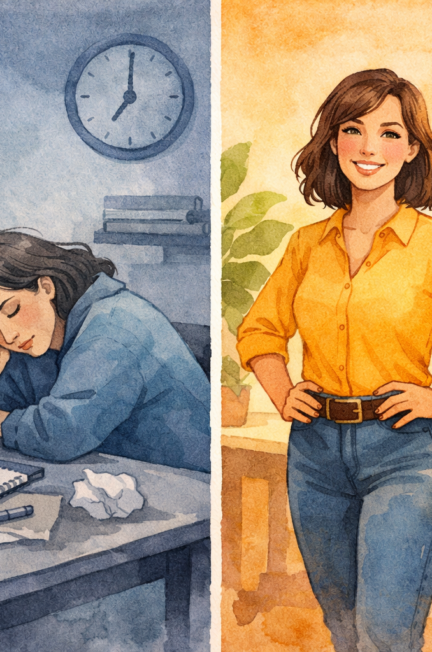
Quick Answer: Feeling behind in life is almost always a comparison problem, not a timing problem. The fix isn’t to speed up — it’s to redefine what “on track” means for your specific life. When women shift from chasing external timelines to measuring progress by their own values and feelings, the sense of being behind tends to fade quickly.

Key Takeaways
- Feeling behind is rooted in comparison, not reality — your timeline is valid
- Reframing goals around how you want to feel (not what you want to have) reduces the pressure significantly
- Celebrating small, invisible wins matters just as much as hitting big milestones
- Your inner dialogue shapes how you perceive your progress — softer self-talk changes everything
- Surrounding yourself with the right people and limiting comparison-triggering content makes a measurable difference
- A simple morning routine (even 15 minutes) can reset your pace for the whole day
- Prioritizing 9 things across A, B, and C categories beats an overwhelming to-do list every time
- Being on a different timeline than someone else says nothing about your worth
Why Do So Many Women Feel Behind in Life?
Feeling behind is one of the most common emotional experiences women carry quietly. It shows up at 28 when a friend announces an engagement, at 35 when someone posts a promotion, and at 45 when the highlight reel of social media makes everyone else’s life look more put-together.
The core issue isn’t that life is moving too slowly. It’s that most women are measuring their progress against someone else’s ruler.
This feeling tends to hit hardest during life transitions — after having kids, after a career pause, after a breakup, or simply after a season of survival mode. And for moms especially, the invisible labor of daily life rarely shows up on any “achievement” list, which makes it easy to feel like nothing is happening when actually everything is happening.

What Actually Causes the “Falling Behind” Feeling?
The feeling isn’t random — it has a few clear sources worth naming.
Comparison culture is the biggest driver. Social media shows curated outcomes, not the full journey. When someone sees a peer’s promotion, new home, or post-baby body, the brain automatically calculates a gap — even when the comparison makes no logical sense.
Borrowed timelines are the second cause. Most people are unconsciously following a script they didn’t write: graduate by this age, marry by that one, own a home, have kids, reach a certain salary. When life doesn’t match the script, it registers as failure — even if the script was never right for that person.
Harsh inner dialogue keeps the feeling alive. If the internal voice responds to every setback with “you’re so far behind,” it becomes hard to see any progress at all, no matter how real it is.
Common triggers include:
- Scrolling social media during low-energy moments
- Attending milestone events (weddings, baby showers, reunions)
- Comparing career progress with peers
- Feeling stuck in a routine that doesn’t reflect personal values
- Recovering from a major life disruption (illness, divorce, loss)
How To Stop Feeling Behind In Life: The Mindset Shift That Changes Everything
The most effective first step is separating timing from self-worth. Being at a different point in life than someone else doesn’t mean you’re doing it wrong — it means you’re doing your version.
Here’s a reframe worth sitting with: no two people are running the same race. A woman rebuilding after divorce, a mom returning to work after years at home, a woman who chose a creative path over a corporate one — none of these are behind. They’re just on different roads.
Try this shift:
| Old Thinking | Reframe |
|---|---|
| “I should have figured this out by now” | “I’m learning at the pace my life allows” |
| “Everyone else seems ahead of me” | “I’m only seeing their highlight reel” |
| “I’ve wasted so much time” | “Every experience brought me here” |
| “I’m not where I thought I’d be” | “Where I am has value too” |
This isn’t toxic positivity — it’s accurate thinking. The “behind” feeling is almost always based on a comparison that was never fair to begin with.
How To Stop Feeling Behind In Life With Feeling-Based Goals
Setting goals around outcomes (job title, weight, income) keeps the finish line forever in the distance. Setting goals around feelings keeps you connected to what actually matters.
Ask: How do I want to feel in six months? Answers like “more at peace,” “more creative,” “less rushed,” or “more connected to my kids” become the actual goal. From there, small daily actions become meaningful because they point toward a feeling, not just an outcome.
This approach also removes the approval trap. When a goal is “get promoted so others see my value,” the goal is dependent on external validation. When the goal is “feel proud of my work,” it’s entirely within reach every single day.
Practical steps for feeling-based goals:
- Write down three feelings you want more of in your life right now
- For each feeling, list two or three small actions that create that feeling
- Do one of those actions daily — no matter how small
- At the end of each week, note one moment when you felt that way
This is how progress becomes visible even when life looks quiet from the outside.
How To Build a Morning Routine That Slows the Spiral
A simple morning routine — even just 15 to 20 minutes — creates a foundation of intentionality that carries through the day. Women who feel constantly behind often describe mornings that start in reaction mode: straight to the phone, straight to the kids’ needs, straight to the to-do list.
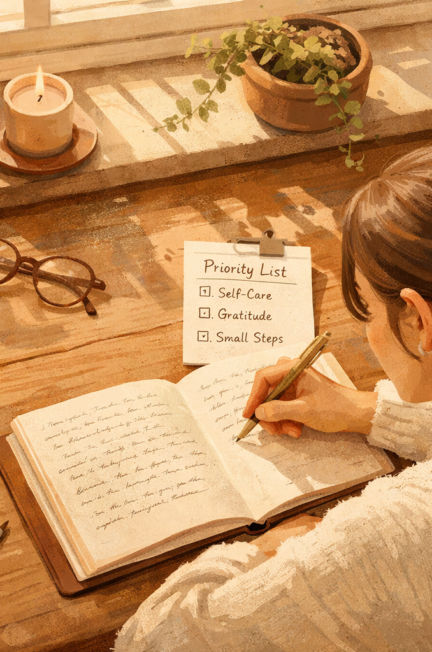
Starting with even one intentional act (a short walk, five minutes of journaling, a slow cup of coffee without a screen) signals to the nervous system that the day belongs to you too.
A simple morning anchor routine:
- 5 minutes of quiet (no phone)
- 5 minutes of movement or stretching
- 5 minutes of journaling or intention-setting
That’s it. Fifteen minutes. It doesn’t need to be elaborate to be effective.
For prioritizing the day, try organizing tasks into three categories: A priorities (must happen today), B priorities (important but flexible), and C priorities (nice-to-do). Aim for no more than three A priorities. This keeps the day focused without the overwhelm of a 20-item list that never gets done.
How To Stop Comparing Yourself to Others (Without Quitting Social Media)
Comparison is the engine behind feeling behind, but the solution isn’t always a full social media detox — it’s being intentional about what gets attention.
Curate the feed. Unfollow or mute accounts that consistently trigger comparison or inadequacy. Follow accounts that reflect the life and values being built, not the life that looks impressive.
Limit passive scrolling. There’s a difference between intentionally checking in with people and mindlessly scrolling at 10pm when energy is low and emotions are vulnerable. The second one is where comparison does the most damage.
Build a real-life circle that matches your values. The people around you shape how you see your own progress. Women who feel inspired by their friendships tend to feel less behind because the conversation shifts from comparison to encouragement.
“You don’t need to shrink your life to fit someone else’s timeline. You need people around you who celebrate the life you’re actually building.”
Expanding What Counts as an Accomplishment
Most women are achieving far more than they give themselves credit for — they’re just not counting the right things.
Invisible accomplishments that deserve recognition:
- Deciding to go to therapy or seek support
- Setting a boundary that felt hard
- Showing up for your kids on a day when you had nothing left
- Choosing rest instead of pushing through burnout
- Staying consistent with something small for weeks
- Asking for help
These aren’t consolation prizes. They are real, meaningful growth. Expanding the definition of accomplishment to include these moments makes it much easier to see how much is actually happening.
Conclusion
Knowing how to stop feeling behind in life starts with one honest question: whose timeline are you measuring yourself against? For most women, the answer is “someone else’s” — and that’s where the feeling loses its power.
Actionable next steps to start today:
- Write down one “invisible” accomplishment from the past month and acknowledge it out loud
- Choose one feeling you want more of and identify one small action that creates it
- Mute or unfollow one account that consistently makes you feel like you’re not enough
- Set a 15-minute morning anchor for the next seven days
- Replace one “I should be further along” thought with “I’m building something that’s mine”
The goal isn’t to catch up. The goal is to feel good about the life being built right now — because that’s the only life there is.
FAQ
Is it normal to feel behind in life in your 30s and 40s?
Yes, and it’s extremely common. These decades often involve major life transitions — career pivots, parenthood, relationship changes — that naturally trigger comparison. The feeling is normal; it just doesn’t have to be permanent.
What’s the difference between feeling behind and actually being behind?
Feeling behind is an emotional experience rooted in comparison. Actually being behind would require a universal timeline — which doesn’t exist. Most of the time, feeling behind is a perception problem, not a factual one.
How do I stop comparing myself to friends who seem more successful?
Start by questioning what “successful” means to you specifically. Then limit exposure to content that triggers comparison, and intentionally celebrate your own progress — even the small, invisible kind.
Can therapy help with feeling behind in life?
Yes. A therapist can help identify the specific beliefs driving the comparison cycle and build more accurate, compassionate ways of measuring progress. Seeking therapy is itself an accomplishment worth counting.
How long does it take to stop feeling behind?
There’s no fixed timeline (which is fitting). For most women, consistent practice of self-compassion, values-aligned goals, and reduced comparison begins to shift the feeling within a few weeks — but it’s an ongoing practice, not a one-time fix.
What if I actually do need to make changes in my life?
Feeling behind sometimes signals a real misalignment — that life is being lived according to someone else’s values rather than your own. In that case, the feeling is useful information. The answer is still not to rush — it’s to get clear on what you actually want and take one small step toward it.
Is the “soft life” or “soft era” trend helpful for women who feel behind?
For many women, yes. The soft era movement encourages prioritizing peace, rest, and personal values over hustle and external achievement — which directly counters the comparison-driven thinking that makes women feel behind.
How do I help a friend who feels behind in life?
Listen without offering comparisons or silver linings. Validate that the feeling is real, then gently remind her of specific things she’s accomplished that she might be overlooking. Avoid phrases like “you have so much to be grateful for” — they tend to shut down the conversation rather than open it.